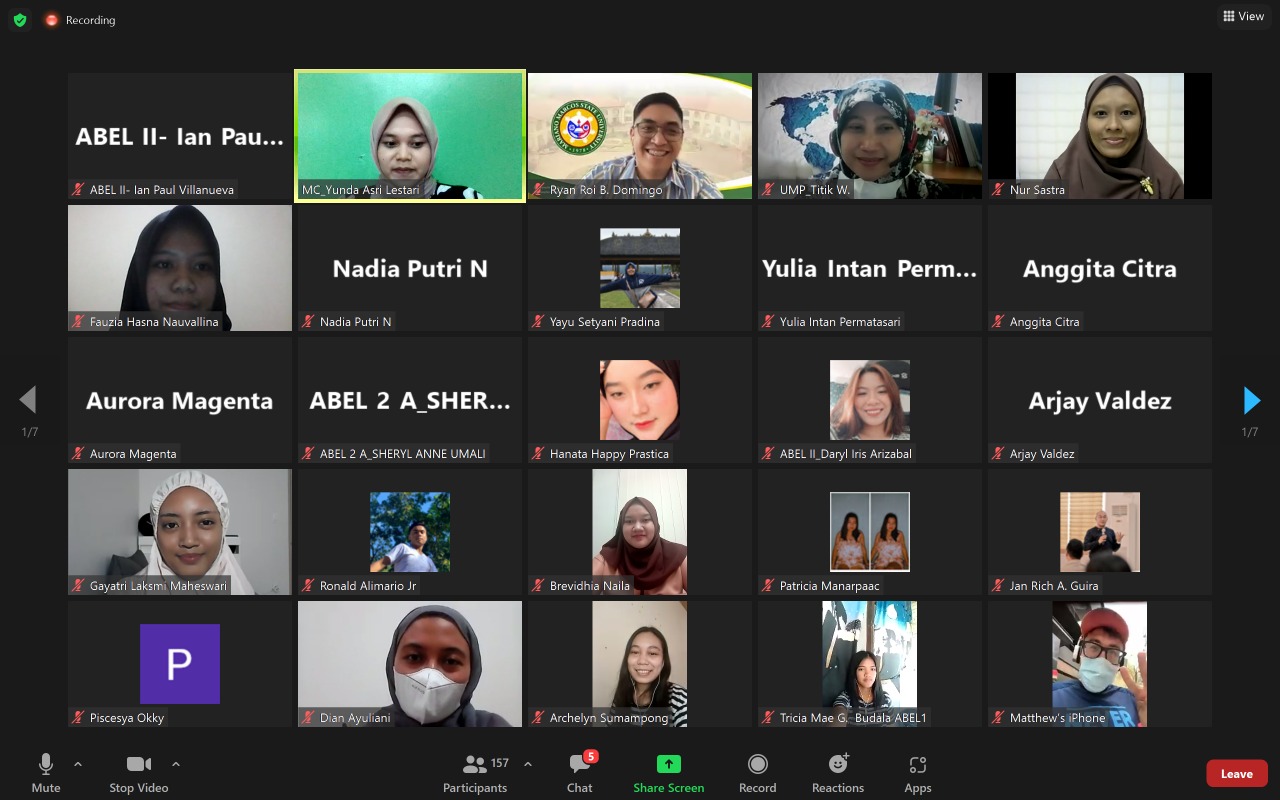


Tuesday, March 29, 2022. Faculty of Letters, Universitas Muhammadiyah Purwokerto (UMP), held an international guest lecture collaborating with Mariano Marcos State University (MMSU), Philippines, on March 29, 2022. The class brought the theme “Thriving in a Globalized World: Embracing Multilingualism and Multiculturalism”, delivered by Prof. Ryan Roi B. Domingo, a lecturer from MMSU. The event started at 12.30 pm (Indonesia Time) with the opening speech by Titik Wahyuningsih, S.S., M.Hum., representing the dean of the faculty. The theme was inspiring and essential to engage students with the knowledge and cross-cultural communication skills necessary for being global citizens.
In his lecture, Ryan exemplified that the Filipino people could speak several languages, including Tagalog as the national language, then English and Spanish. It signifies them as multilingual people or living the multilingualism. It may occur due to some factors, namely the British colonization that had impacted the growth and use of the English language among the Filipinos. Besides, the emergence of the national language under the Philippine constitution article in 1935 has given an advantage for the Filipinos to experience multilingualism. It further grows out of the increase in migrations and intercultural marriages that impact mixing the languages they use daily. At last, the use of technology and multilingualism regulation in education play essential roles in strengthening the condition. Ryan added that multilingualism is common in heterogeneous societies, such as in Indonesia. Its use in education should have positive impacts, like creating language diversity or multiculturalism due to the various languages. Why multiculturalism? In multiculturalism, we recognize and respect social differences and cultural backgrounds as a grace, gift, and wealth God has given us. If we can apply this multiculturalism well, we will no longer see the identity attributes of differences between us as threats or social crimes. (Chav)
Related Posts

How to Turn Education into Success
Posted onThis is a post with post type “Link”
Posted on