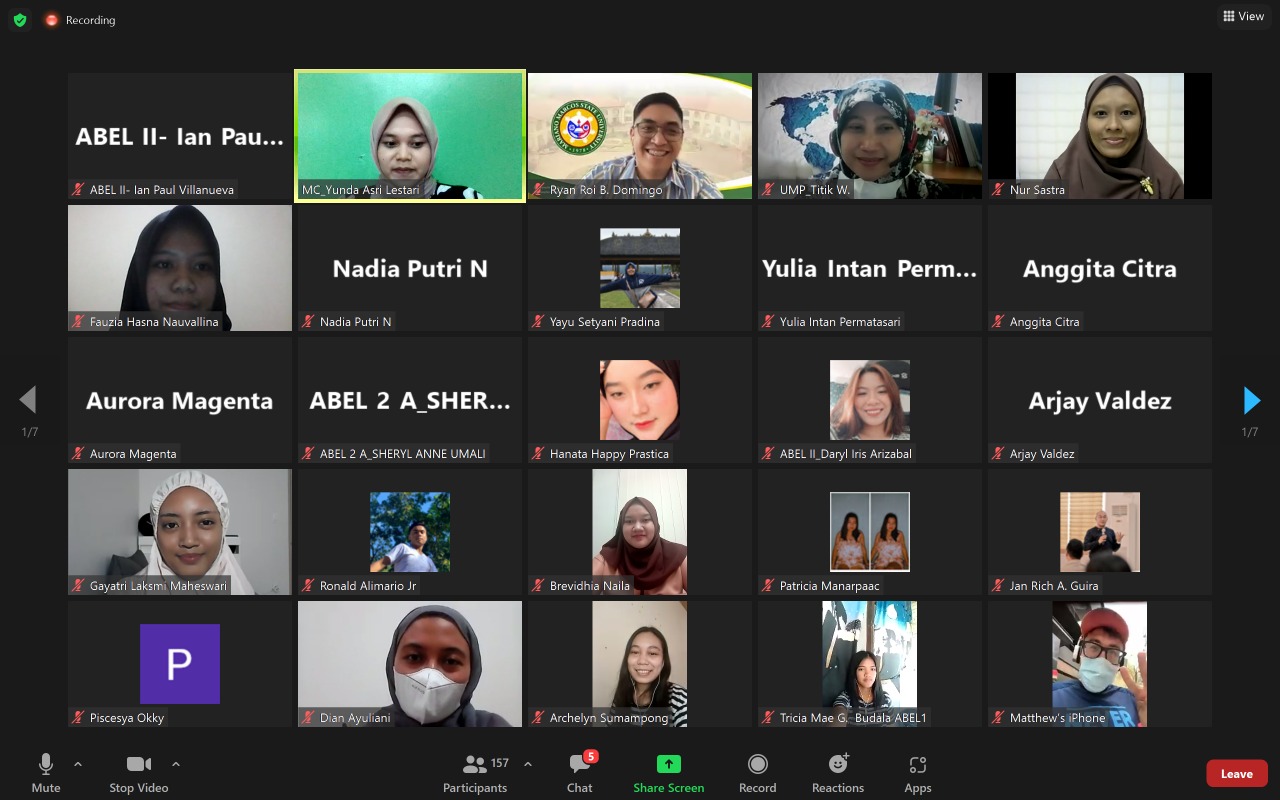
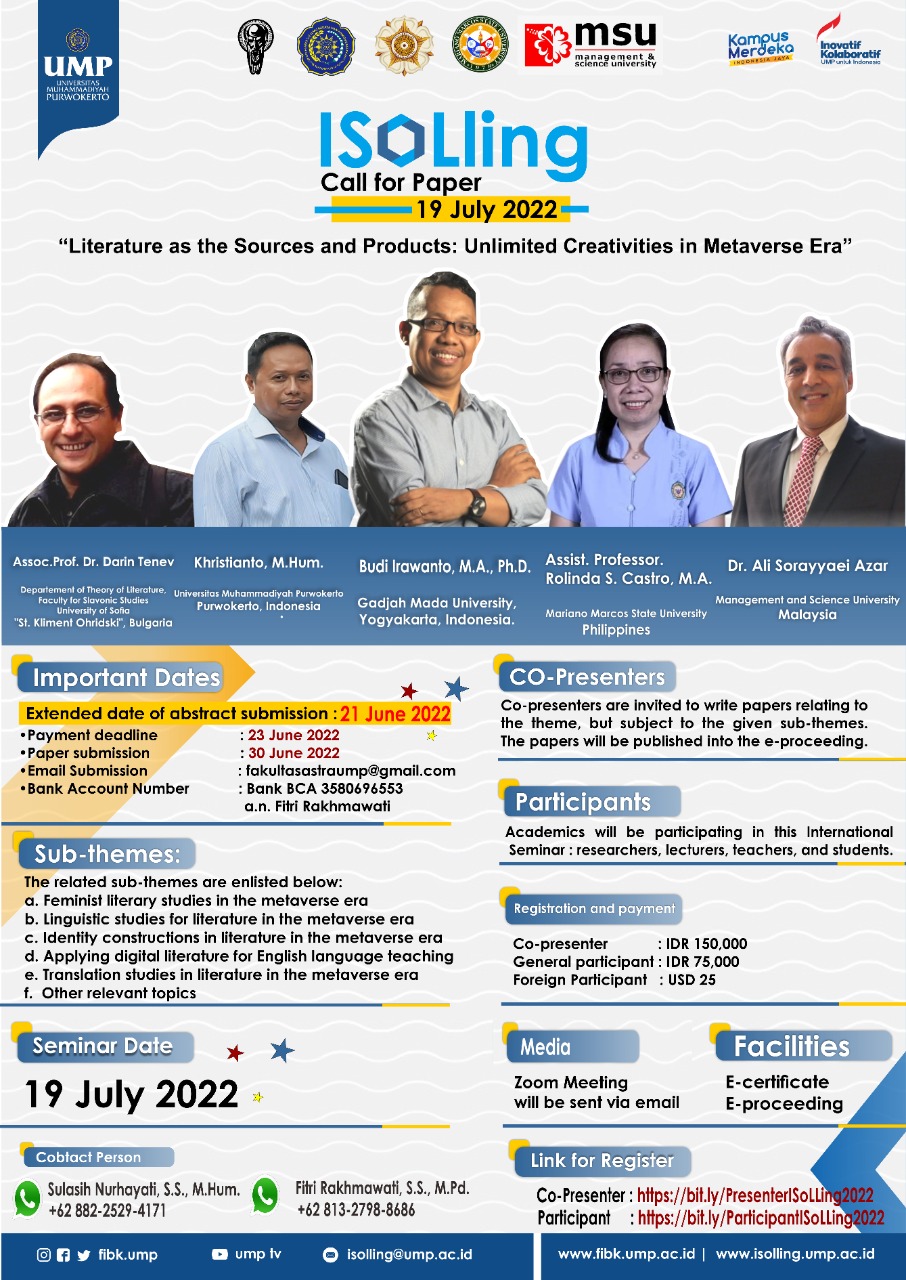

Purwokerto, Tuesday, 19 July 2022. Holding international seminars is one of the key performance indexes for a study programme. It is a forum where current research results are disseminated, insisting that universities and study programmes are responsible for developing, inventing, and publicizing those studies that will impact societies worldwide. Therefore, the Faculty of Cultural and Communication Sciences, UMP, always commits to holding two international conferences annually. The first forum focuses on Teaching English as a Foreign Language (COTEFL); while the other is on linguistics and literature (ISOLLING). This year, Isolling is thirdly held, bringing a grand theme on literature as the sources and products: unlimited creativities in the metaverse era. The theme is essential in response to the fast growth of the digital age to which literature may adjust on its roles as becoming the sources and products of innumerable creativities.
Concerning this, the event invited five speakers from abroad and Indonesia and was attended by more than 150 Indonesian and foreign participants. Those international speakers are from Bulgaria, the Philippines, and Malaysia, while the others are from Indonesia. In the keynote session, Budi Irawanto, Ph.D. from Gadjah Mada University, highlighted the critical role of the literature growth in the metaverse era for nurturing empathy. In brief, the period facilitates any creativities, including in literary productions, to develop and grow. Yet, they should all function to raise and enhance empathy towards inaudible and invisible spectacle rather than the narcissism of difference, participation in the imaginary community and submission to the low entertainment.
In line with the keynote speaker, Dr Darin Tenev, from Sofia Univesity, Bulgaria, presented the essential effect of the metaverse era on the modality inclinations of literature. Specifically, he argues that the period has given the “freedom” for its users to be unlimited creators of whatever they want in the meta world. For literature, it may be a challenge to its future existence, mainly how it is (re) reconceptualized more and more regarding the (multi)metaverse. On the other hand, Assist. Prof. Rolinda Sadornas Castro, from Mariano Marcos State University, Philippines, distinctly discussed the role of the metaverse in the educational field. She focused on how technology may help enhance students’ active involvement in the literary classrooms through team projects and peer gradings.
During the metaverse, the covid-19 pandemic occurred and remained a traumatic experience for its survivors. Dr. Ali Sorayyaei Azzar, from Management and Science University, Malaysia—as one of the invited speakers—analyzed the appearance of pandemic discourse in his study on the relationship between the pandemic and the era. It exists in the traumatic speech act that appears in the media produced during the time. Such traumatic expressions, like lockdown, viral pneumonia, booster, and the like, arose and spread across the media and created a discourse of fear. Impressively, Khristianto, M.Hum, the last speaker of the conference, added that the metaverse era also gives chances for true cybercrime fiction to grow and become the source and product for literary (re)productions.
All the speakers presented insightful ideas that marked the seminar’s success. Still, essential issues will be running on and on to the seemingly never-ending debates. So, see you again in the next Isolling. (nur)